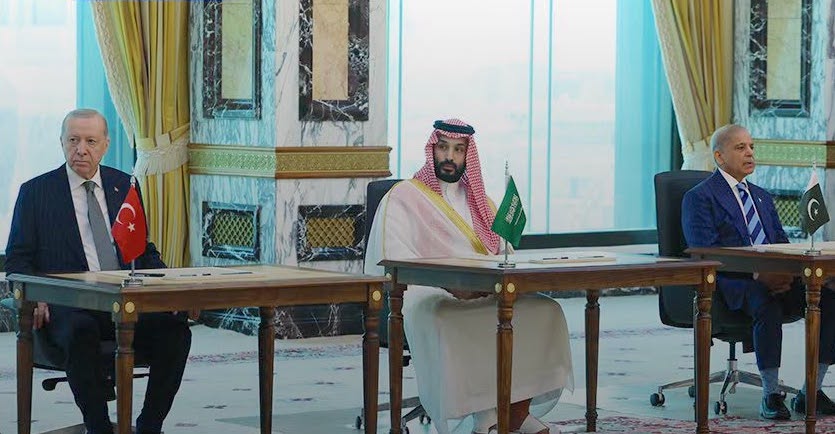
By Janet Ekstract, ISTANBUL- Turkiye’s significance in the Middle East has upleveled with the establishment of the Mecca Joint Defense Agreement signed on August 7, 2026 by Turkiye, Saudi Arabia and Pakistan. The agreement is a historic collective security arrangement directly modeled after NATO’s Article 5, that states an armed attack against one member state is considered an attack against all. Analysts point out that such a defense pact has enormous geopolitical, strategic and industrial value for Turkiye, positioning it as the cornerstone of a new regional security bloc. A major focus for Turkiye is defense-industrial cooperation as the accord secures critical Gulf funding from Saudi Arabia for Turkiye’s advanced military projects. This includes the localization of the Akinci combat drone and expanding Saudi financial participation in Turkiye’s KAAN fifth-generation fighter jet program.
Meanwhile, Iran has been invited for talks and dialogue regarding the security pact and Turkish Foreign Minister Hakan Fidan stated that the pact does not target Iran. Turkish diplomacy has been actively engaging to ensure this alliance is used as a mechanism to stabilize regional escalations between Iran, Israel and the U.S. The Iranian Foreign Ministry confirmed that proposals and talks regarding the pact have been taking place but that no formal invitation was issued for Iran to join. Founding members of the agreement have created a model where Turkiye, Saudi Arabia and Pakistan remain the core but the pact is open to expansion for what they refer to as “brotherly countries.” To that end, a top contender is Egypt with Turkish officials calling Egypt a “natural partner” and stating that Cairo would probably enter the alliance once remaining “technical issues” are resolved. Egypt brings enormous frontline manpower and control over the strategic Suez Canal. Fidan also confirmed that a number of other regional countries expressed interest in joining, some prefer to remain anonymous while protocols are being established.
Political analysts view the Mecca Joint Defense Agreement as a highly complex strategic pivot for Turkiye while geopolitical experts remain divided between the pact’s immense industrial benefits and its severe regional risks. Experts agree that the pact is a massive commercial and technological victory for Turkiye with a powerful triad – Saudi Arabia providing capital, Pakistan providing frontline military manpower and Turkiye providing advanced defense-industrial infrastructure. For Turkiye, the agreement quickens the export and joint production of Turkish deep-tech, including unmanned aerial vehicles (UAVs), naval platforms and electronic warfare systems. Where political commentators have raise questions concerns how Turkiye will manage the escalating conflict involving the U.S., Israel and Iran. Though Turkish officials have insisted that the agreement is “non-directional,” with no aim to target Iran, regional analysts warn that the agreement’s text technically binds Turkiye to defend Saudi Arabia from Houthi or Iranian missile strikes. Think tanks such as the Eurasia Review, highlight that Turkiye’s primary challenge is preventing automatic entanglement in Gulf wars while preserving its diplomatic channel with Tehran. Analysts note that Turkiye, as a long-standing NATO member, faces a complex legal and diplomatic task to integrate this new “Islamic collective defense” framework with its Western treaty commitments. International policy experts including those at the Council on Foreign Relations, view the accord as a clear signal of eroding U.S. leadership in West Asia and view Turkish involvement as “strategic hedging” – securing a central leadership role in a post-American regional security order without officially cutting ties with the West.