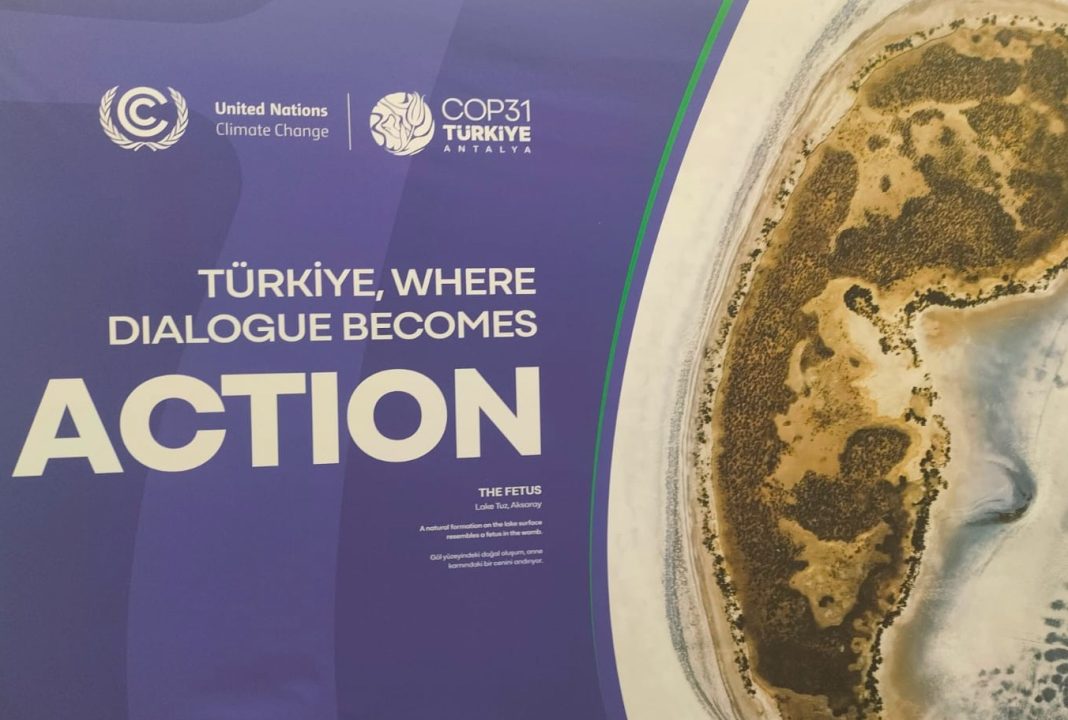
By Janet Ekstract, ANTALYA- As the 31st U.N. Climate Change Conference (COP31) begins on November 9 in Antalya, Turkiye, the EU and its 27 member states, accompanied by 77 members of the Organization of African, Caribbean and Pacific States (OACPS) signatories of the Samoa Agreement, reaffirmed their commitment to the full implementation of the Paris Agreementand to strengthening their cooperation on climate action ahead of COP31. In a joint statement, partners underscored how urgent it is to accelerate global efforts to limit global warming to 1.5 degrees Celsius with special emphasis on the vulnerability of developing countries. Meanwhile, in their opening remarks on the first day of the COP31 conference, COP31 President and Turkiye’s Minister of the Environment, Murat Kurum and U.N. Climate Change Executive Secretary, Simon Stiell and President of COP31 Negotiations Chris Bowen of Australia, gave their opening remarks. Stiell highlighted a “new era of implementation,” at COP31 that includes: “Not discarding what went before. But building on it. Honing it. To deliver progress faster.” As climate experts and observers have pointed out, there is a major gap between countries who actually implement climate change actions and those who verbally commit but take no action as well as inequality especially among developing nations. As Stiell echoed: “But progress is nowhere near far enough or fair enough.”
To that end, the 2026 COP31 features a “unique partnership between Turkiye and Australia,” Stiell said that has nations “Driving solutions across both the negotiations and the Action Agenda,” he added. As COP31 President Kurum said: “This is Antalya’s call: let dialogue grow as divisions deepen. Restore trust where it is under strain. Put resources to work as needs grow. Close the gap between our promises and people’s lives.” Meanwhile Stiell noted the progress in climate actions that include “90% of large renewable projects are now cheaper than fossil fuel alternatives,” adding “And adaptation is moving from the margins to the mainstream.” He added that major issues involve delivering on the “tripling of finance for adaptation,” mitigating the “immense frustration countries face in accessing committed, available finance” and finding solutions to “triple global renewables capacity by 2030. “Another issue, Stiell said is to cut “super-polluting methane emissions,” specifically in oil and gas as well as waste sectors that include “learning from leading energy producers.” He also said that transporting energy across grids and borders is essential “to power the electric age.”
Meanwhile, Kurum said: “That is why climate policy today is also development policy. It is food policy. Energy policy. Urban policy. Health policy.” He understored that climate policy is “how we protect humanity’s future,” adding “We may come from different places. Our circumstances, resources and priorities may differ. Yet, we increasingly share the same climate calendar.” Stiell warned that “fossil fuel cost chaos” has created a “global shockwave” that has hit household costs hard and caused ubiquitous inflation. He cautioned that “The fallout has been severe” economically and politically. Stiell reiterated the goals behind U.N. Climate Change are to “support countries” to fully engage with the Action Agenda. He added that his organization is “working on a moment on the final day of the COP, bringing together progress made over these two weeks.” He said U.N. Climate Change is seeking ways to “support government counterparts to boost collaboration with non-party stakeholders, and mobilize action towards shared priorities.” Kurum highlighted the importance of Turkiye “as a bridge” and said “We are ready to take on that responsibility again. He stressed that the goal is finding “common ground” that demonstrates the expectations of North and South, “of developed and developing countries.” The COP31 president concluded: “Together with Australia, we are ready to ensure the Pacific is heard and to help find solutions to the challenges facing vulnerable countries.”
In addition, the Turkish environment minister warned that delaying investments in resilience today will only result in facing “the cost of a disaster.” As Kurum explained: “Fail to deliver adaptation finance today, and tomorrow’s humanitarian crisis may be worse. The costs we will face in the future must therefore inform the decisions we take now. The 1.5°C goal remains our guide. We will be frank about what the science tells us. And we will bring the voices of the most vulnerable countries and communities to the center of our agenda.” He said: “I appeal to countries, peoples and young people everywhere,” adding “Let us make Antalya the starting point of a historic partnership. Let our promises deliver results. Let our decisions unlock investment. Let our knowledge be put to work.” As Kurum so poignantly stated: “A decision proves its worth when it makes a difference to someone’s life.”