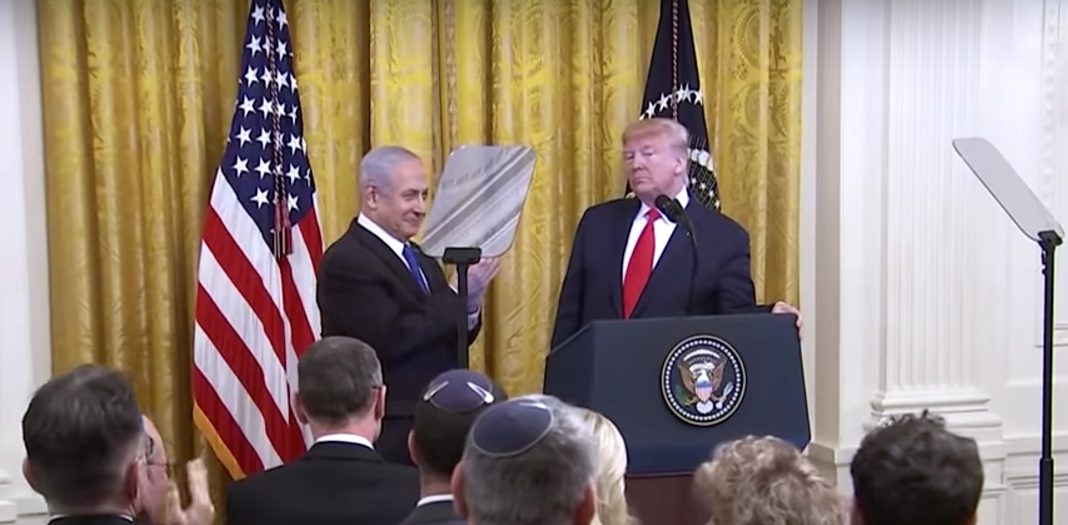
By Janet Ekstract, NEW YORK- Prime Minister Binyamin Netanyahu met U.S. President Donald Trump in a three-hour meeting on Wednesday, February 11. After the meeting, Trump told reporters that “nothing definitive” was decided but he said he told Netanyahu he prefers to reach a deal with Iran on its nuclear enrichment. Netanyahu also met with U.S. Secretary of State Marco Rubio and announced during his visit that Israel has now joined Trump’s “Board of Peace.” The Board of Peace is controversial for a number of reasons, not the least of which is the fact that Netanyahu and Russian President Vladimir Putin, both accused of committing genocide, have been invited to be on the board. Numerous rights experts have expressed doubt about the board since they said that Trump supervising a board to oversee a foreign country’s affairs could be compared to a colonial situation. Since the board includes no Palestinians, analysts said Israel’s presence on the board could be expected to engender major criticism.
Meanwhile, U.S. allies have reacted with caution to Trump inviting them to join the board that was launched in late January, and a number of experts feel the board could undermine the role of the United Nations. While some Mideast U.S. allies have joined the board, a majority of western allies, have not. With the ceasefire in Gaza having been repeatedly violated, many observers and experts on the region question the efficacy of a “Board of Peace.” The next phase of Trump’s Gaza plan includes resolving complex issues like Hamas’ disarmament, additional Israeli withdrawal from Gaza and the deployment of an international peacekeeping force. In mid-November a U.N. Security Council resolution was adopted which authorizes the board and countries working with it, to establish an international stabilization force in Gaza. Ultimately, the board is supposed to oversee Gaza’s temporary governance and much later, the board will expand with an eye toward expanding to solve global conflicts. At issue is the stabilization force which has been exceedingly slow to take shape because the security situation in Gaza remains tense with four Israelis and close to five hundred Palestinians killed since the ceasefire. Analysts also highlight the major discrepancies between Trump’s optimistic outlook and the reality on the ground. According to experts, the primary threat to the stabilization process is whether there is truly a commitment to demilitarize Gaza that includes disarming Hamas. This is also a reason for the delay in forming the International Stabilization Force (ISF) and the Palestinian internal security force that are supposed to take on this responsibility. The board is scheduled to hold its first meeting on February 19 in Washington to discuss Gaza’s reconstruction.