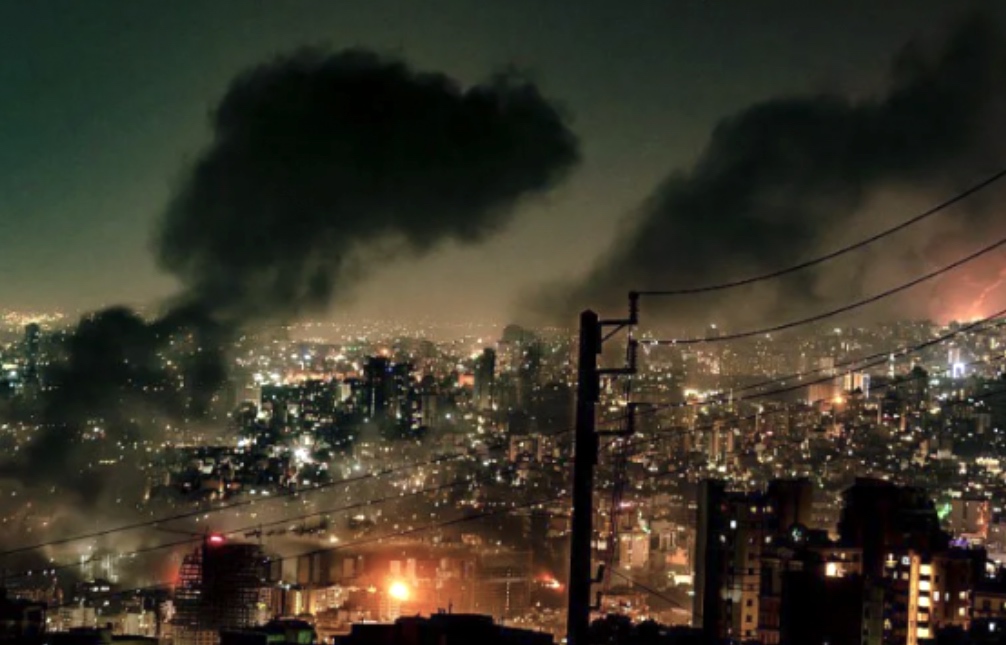
Strikes on primarily civilian infrastructure causing foreseeable civilian harm are violations of international humanitarian law and are likely war crimes.
BEIRUT – Israeli attacks on four oil depots around Tehran on March 7, 2026, may cause long-term health and environmental harm for civilians, Human Rights Watch said today. Strikes on primarily civilian infrastructure causing foreseeable civilian harm are violations of international humanitarian law and are likely war crimes.
On March 8, Iran’s state-owned oil distribution company reported that “four sites used for storing and distribution of petroleum products and a petroleum products transport center in the provinces of Tehran and the Alborz were attacked by hostile enemy aircraft.” That day, the Israeli military posted on X that it had targeted “several fuel storage complexes belonging to the IRGC [Islamic Revolutionary Guard Corps] in Tehran.”
“Israel’s March 7 attacks on oil depots surrounding Tehran may have devastating consequences on the environment and people’s health for many years and likely amount to war crimes,” said Bahar Saba, senior Iran researcher at Human Rights Watch. “Israeli forces don’t appear to have factored in the foreseeable long-term harm in the Tehran vicinity, for which they should be held accountable.”
Human Rights Watch spoke directly or through third parties with eight people in Tehran and Karaj about the effects of the strikes, and to nine environmental and health experts. Researchers analyzed satellite imagery and verified videos related to the attacks. Human Rights Watch wrote to Israeli and Iranian authorities on March 26 for further clarification regarding the attacks. Iranian authorities have not responded.
The Israeli authorities responded on March 30, stating that the attacks “were conducted in accordance with the principles of distinction, proportionality, and precautions.” They stated that the oil depots attacked “were designated to provide fuel directly to units in the regime’s armed forces, in support of the operation of military aviation, UAVs [unmanned aerial vehicles] naval vessels, and other military infrastructure.”
Human Rights Watch confirmed that the oil depots were used for civilian purposes but was not able to determine whether they were also used to support the military. One informed source said that the oil depots only contained gasoline and diesel, which would not be used for aviation, UAVs, or naval vessels.
Human Rights Watch confirmed the attacks on the four oil depots using satellite imagery and verified videos, some geolocated by the volunteer group GeoConfirmed.
Satellite imagery from March 9—more than 24 hours after the strikes—shows large smoke plumes arising from the Shahran, Aghdasieh, and Shahr-e Rey oil depots.
March 11 imagery shows destroyed fuel storage tanks in the Fardis oil depot. Alborz University of Medical Sciences reported that a dialysis center near the Fardis depot “was set on fire and its equipment and building were destroyed” during the attack. High-resolution satellite imagery from March 18 shows apparent damage to a medical facility and a primary school near a destroyed oil tank in the Fardis oil depot.
Satellite imagery from March 11 also shows a black smoke plume rising from the Shahr-e Rey depot toward central Tehran. Dozens of fuel storage tanks are visibly damaged or destroyed across the four sites on imagery from March 17, including fire and smoke billowing from the Aghdasieh oil depot.
The governor of Alborz province said that the strike on the Fardis oil depot had killed at least six people and injured 21 others, which could not be verified. There were no reported casualty figures for the other three attacks.
A woman in northern Tehran told Human Rights Watch, “The day after they hit [the oil depots], you couldn’t see the sky – it was black.”
“The city looked apocalyptic,” said a woman from Shahrak-e Gharb in northwest Tehran. “The facades of the white buildings, cars, mosaics in the courtyards, flower bushes and plants, and the city’s cats were covered with a layer of black soot.”
Residents described respiratory symptoms immediately after the attacks such as shortness of breath, continuous coughing, chest pain, and skin and eye irritation.
Environmental and health experts said that the attacks on oil depots caused the emission of dangerous air pollutants, both gaseous and visible, that could cause acute and chronic health effects on nearby residents, possibly for decades.
The United Nations Environment Program stated on March 13 that, “Heavy smoke from burning oil, which includes hazardous compounds, is now being directly inhaled by people in Iran−including young children−raising serious concerns about long-term impacts on both human and environmental health.… Pollution from uncontrolled fires may also enter soil and water, leach into groundwater, and be absorbed by crops, contaminating food supplies.”
The World Health Organization (WHO) said that the attacks “raised concerns of wider regional pollution exposure and the toxic pollutions and pollutants that affect respiratory health and contaminate water can have long-term effects.”
Under the laws of war applicable to the international armed conflict in Iran, attacks may only be directed at military objectives. Warring parties must take all feasible precautions to minimize harm to civilians and civilian objects, including by avoiding placing military targets near densely populated areas.
Oil depots and other energy infrastructure are presumptively civilian objects, but they can become military objectives if used to support the military. However, attacking them would be unlawfully disproportionate if the expected harm to civilians and civilian structures exceeded the anticipated military gain.
The International Committee of the Red Cross guidance provides that proportionality assessments need to consider “reasonably foreseeable” indirect environmental impacts. These include long-term or “reverberating” effects on the water, food systems, and the health of civilians. Attacks against military objectives are also unlawful if they are expected to cause “widespread, long-term and severe” damage to the natural environment, measured in months or years.
Serious violations of the laws of war ordered or committed with criminal intent—that is, deliberately or recklessly—are war crimes.
In addition to ensuring that the oil depots were military objectives, Israeli forces should have taken into account the foreseeable long-term consequences of the attacks on the environment and on people’s health, Human Rights Watch said.
Iranian forces have targeted oil and gas infrastructure in other countries, including in Bahrain, Kuwait, Oman, Qatar, Saudi Arabia, and the United Arab Emirates.
“Israel, as well at the United States and Iran, should be on notice that the laws of war provide specific protections for the environment,” Saba said. “Attacks targeting oil and gas infrastructure are likely to affect millions of people far longer than the conflict itself.”