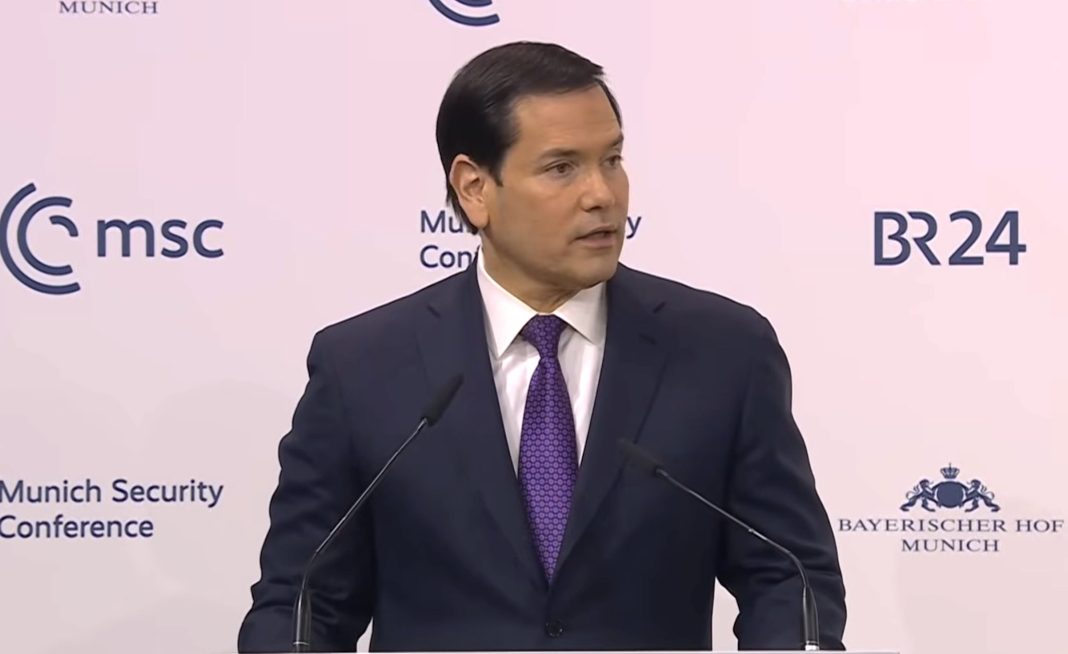
By Janet Ekstract, ISTANBUL- As the 62nd Munich Security Conference kicked off on Friday, February 13 at the Bayerischer Hof Hotel in Munich, Germany, more than 60 heads of state and government along with 50 leaders from international organizations and participants from 115 countries, convened. On the first day of the conference, French President Emmanuel Macron and German Chancellor Frederich Merz spoke with Macron calling for a “strong Europe” while Merz acknowledged a “rift” between the U.S. and Europe. There were hints of trepidation at what U.S. Secretary of State Marco Rubio would say in his address on February 14, the second day of the conference as European leaders recalled the scathing speech U.S. Vice President JD Vance gave at last year’s conference. But Rubio surprised European leaders by delivering a message of unity while underscoring the historical significance of the European-U.S. alliance. Rubio said: “We belong together,” stressing the decades of partnership between the Europe and the U.S. – reassuring European allies that the Trump administration is committed to an alliance with Europe. Rubio also hailed a “new era in geopolitics,” and said “Together we can not only take back control of our own industries and supply chains, we can prosper in the areas that will define the 21st century.” Though Rubio cautioned “But we must also gain control of our national borders,” and reiterated that it’s “not xenophobia” but “a fundamental act of national sovereignty” to control migration. Not to do so, Rubio said puts both Europe and the U.S. in danger. As Rubio remarked: “It is an urgent threat to the fabric of our societies and to the survival of our civilization itself.” He concluded that what’s crucial is not to dismantle the organizations that the U.S. and Europe created and belong to – what’s essential is to “reform” them, Rubio said.
The U.S. diplomat made it clear when he said: “We care deeply about your future and ours,” adding “And if we disagree, our disagreements come from a profound sense of concern about a Europe which we are connected, not just economically, not just materially. We are connected spiritually and we are connected culturally.” As Rubio concluded, he emphasized: “We want Europe to be strong, we believe that because the two great wrs of the last century served as history’s constant reminder that ultimately our destiny is and will always be intertwined with yours because we know that the fate of Europe will never be irrelevant to our own.”
Meanwhile, prominent U.S. democratic lawmakers are attending the conference in the hopes of urging European leaders to stand up to Trump whose erratic political behavior has not only Europe on edge, but Republicans as well. Those democrats include California’s democratic governor Gavin Newsom, New York Congresswoman Alexandria Ocasio-Cortez, Arizona senator Ruben Gallego and Michigan governor, Gretchen Witmer. Newsom told European leaders that “groveling to Trump’s needs” makes them “look pathetic on the world stage” while Gallego commented: [Trump] is destroying our world reputation or potentially our economic might around the world because he is being petty. None of this is rational. Everyone needs to stop pretending this is rational.” Striking a conciliatory note was NATO Secretary General Mark Rutte who said Europe must be on good terms with U.S. President Donald Trump and Rutte has managed to maintain a very good relationship with him. On the European front, EU Commission President Ursula von der Leyen said: “Europe must become more independent, there is no other choice,” as she emphasized how the world has become more fractious and how “outside forces” are trying to disrupt Europe. Merz echoed her warning when he said: “In the era of great power rivalry, even the United States will not be powerful enough to go it alone,” adding “Dear friends, being a part of NATO is not only Europe’s competitive advantage, it’s also the United States’ competitive advantage.” As Rubio pointed out in his speech, “It was here in Europe” where he said, the seeds of ideas and destiny for the creation of the U.S. originated. Rubio acknowledged that “Europe produced the genius of Beethoven, of Dante, of Shakespeare, of Michael Angelo and Da Vinci,” underscoring that Europe and the U.S. should be “unapologetic in our heritage.”