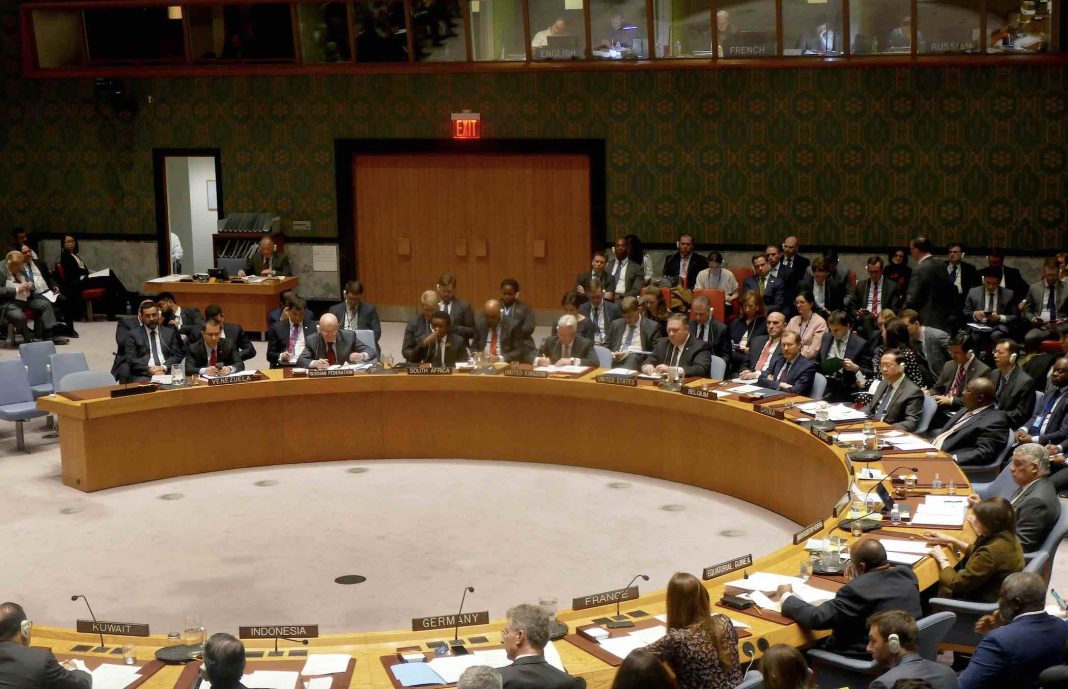
By Janet Ekstract NEW YORK – On November 17, the U.N. Security Council (UNSC) passed a U.S. resolution that authorizes an international stabilization force to provide security in Gaza, approves a transitional authority that will be directed by U.S. President Donald Trump and that envisions a possible future path to an independent Palestinian state. Posting on social media, Trump wrote: “This will go down as one of the biggest approvals in the History of the United Nations, will lead to further Peace all over the World, and is a moment of true Historic proportion!” The U.N. vote endorses Trump’s 20-point ceasefire plan, building on the tentative ceasefire. It is a key step to shore up a future for Gaza and its people. The framework is set to include a not yet established Board of Peace as a transition authority headed by Trump. It will provide a wide mandate for the international stabilization force, including overseeing the borders, providing security and demilitarizing the territory. The authorization for the board and force expire at the end of 2027. Arab countries and other Muslim nations who showed interest in providing troops for in international force had made it clear that U.N. authorization was crucial for their participation.
Meanwhile, Hamas is opposed to the resolution because the group stated that the framework does not meet the “Palestinian people’s political and humanitarian demands and rights.” U.S. Ambassador to the U.N. Mike Waltz lauded the resolution, stating that it “represents another significant step towards a stable Gaza that will be able to prosper and an environment that will allow Israel to live in security.” What the framework doesn’t guarantee is a timeline for an independent Palestinian state and it’s common knowledge that Israeli Prime Minister Netanyahu is dead-set against such a move as is the far-right in Israel. The framework only states that a Palestinian state is possible after advances in Gaza’s reconstruction and reforms in the Palestinian Authority that now governs parts of the West Bank. The U.S. revised the resolution to state that after those steps are taken “the conditions may finally be in place for a credible pathway to Palestinian self-determination and statehood.” It also stated: “The United States will establish a dialogue between Israel and the Palestinians to agree on a political horizon for a peaceful and prosperous coexistence.”
Key to the adoption of the resolution was the support from Arab and other Muslim nations that was critical to the ceasefire and the formation of an international stabilization force. The U.S. Mission to the United Nations distributed a joint statement on November 14 along with Qatar, Egypt, United Arab Emirates, Saudi Arabia, Indonesia, Pakistan, Jordan and Turkiye, calling for “swift adoption” of the U.S. proposal. Meanwhile, the Algerian U.N. Ambassador Amar Bendjama, the Arab representative on the council, reminded everyone: “genuine peace in the Middle East cannot be achieved without justice, justice for the Palestinian people.”