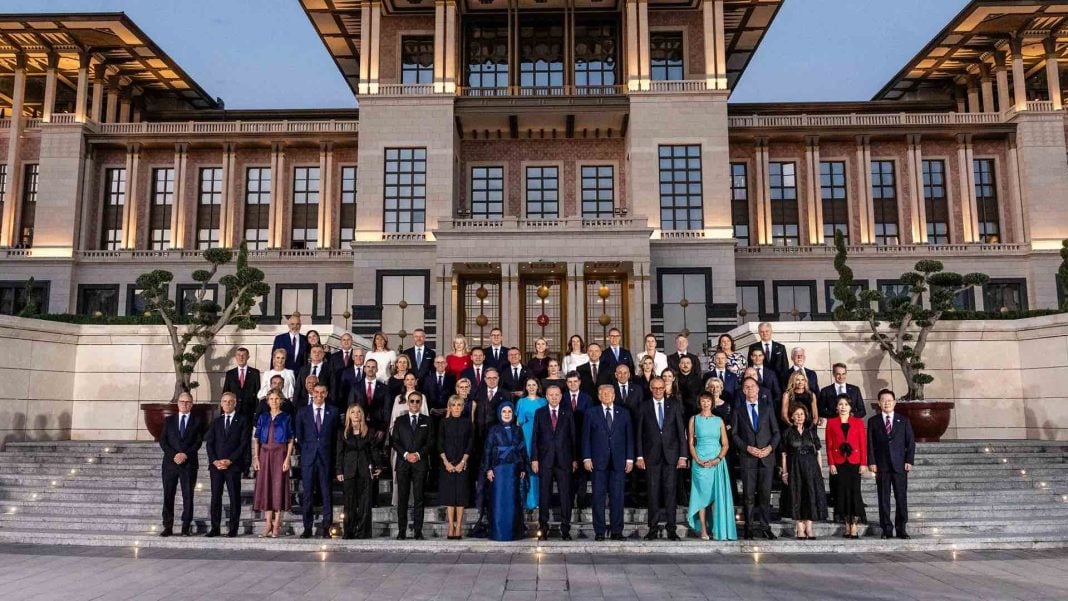
By Janet Ekstract, ISTANBUL- The 36th NATO summit held in Ankara, Turkiye, whose focus was all about European defense, saw landmark defense industry agreements signed. There was a multi-billion USD pivot to technological modernization and a structural transition to what NATO Secretary General Mark Rutte has dubbed NATO 3.0. Rutte officially introduced NATO 3.0, a framework designed to have European allies and Canada as the main conventional forces on the ground with support from U.S. nuclear and strategic capabilities. The summit saw numerous defense agreements formalized with a scenario where European allies would assume a role of conventional territorial first-responders, making way for the U.S. to shift its focus to extended strategic deterrence. The summit also highlighted Turkish success in the defense industry with Turkiye’s advanced uncrewed systems and the possibility that U.S. President Trump will lift sanctions on Turkiye and complete a long-awaited F-35 deal. In his opening remarks on the first day of the summit, Rutte praised U.S. President Donald Trump for his “leadership” in pushing EU leaders to rethink their defense budgets, which Rutte said has resulted in a rebalancing of NATO.
Meanwhile, leaders reviewed progress in working toward a 5% GDP defense spending goal by 2035 that would include 3.5% for core defense and 1.5% for broader security that was created in The Hague in 2025. Five allies have hit the 3.5% core projection for 2026, with European and Canadian average defense spending up to 2.53%. Member nations signed a combined 50 billion euro ($57 billion) in new procurement contracts that target integrated air defenses, space capabilities, deep precision strike weapons and uncrewed systems. In a first for the alliance, it formally launched NATO’s Drone Edge, a $40 billion initiative scheduled for deployment over the next five years to build out unified counter-drone and autonomous aerial marketplaces.
The official Ankara Summit Declaration emphasized three main points that included reaffirming Article 5 with leaders stating their “ironclad commitment” to collective defense, making it clear that an attack on one member is an attack on all. The 360-Degree Deterrence means the Alliance commits to maintaining a baseline approach covering all security threats, especially identifying Russia as a “long-term threat” to Euro-Atlantic stability. Burden Sharing was also front and center with European Allies and Canada announcing they will assume greater responsibility for defense, already having boosted core defense investments by over $139 billion in 2025 to track toward the 5% GDP target set at the 2025 Hague. A significant move, confirmed in the Ankara Summit Declaration is the Digital Warfare Cloud to consist of a collective development of an interoperable transatlantic warfighting cloud and the widespread integration of advanced AI models. Ukraine received a pledge of 70 billion euro ($80 billion) in direct military assistance and training for Ukraine throughout 2026 while guaranteeing an equivalent baseline for 2027. In a meeting with President Trump, Ukraine was granted a license to domestically manufacture Patriot air-defense missile systems. The declaration also states that Iran must never develop a nuclear weapon and that Tehran must fully respect international maritime traffic in the Strait of Hormuz.