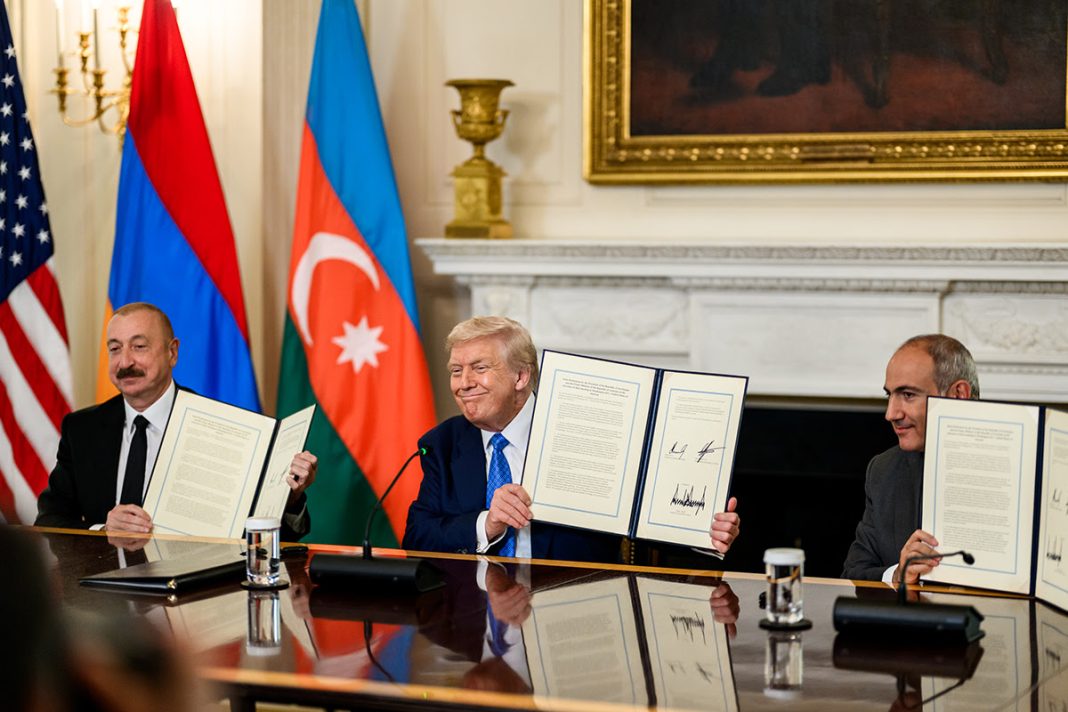
By Janet Ekstract- On Friday, August 8, 2025 at a White House summit, U.S. President Donald Trump announced a U.S.-brokered peace agreement between Azerbaijan and Armenia. The agreement was signed with Azerbaijani President Ilham Aliyev, Armenia Prime Minister Nikol Pashinyan and U.S. President Donald Trump that brings an end to decades of conflict between the two nations and paves the way to normalize relations between the two countries. The agreement includes provisions for reopening transportation routes, resuming diplomatic relations and developing economic cooperation. A key element of the agreement is the creation of a transit corridor to be known as the “Trump Route for International Peace and Prosperity” that will connect Azerbaijan to its Nakhchivan region with the potential to boost regional trade and development. The agreement is especially significant for the South Caucasus region on a number of fronts. The U.S. president and his team had been instrumental in facilitating the talks that led to the agreement which will also end clashes over the region of Nagorno-Karabakh. The reopening of key transport routes has a great potential to exponentially increase trade and economic business. Meanwhile, the U.S. will assist in building the major 20-mile transit corridor dubbed the “Trump Route for International Peace and Prosperity,” allowing Azerbaijanis direct access to their country’s westernmost region, according to Hudson Institute senior fellow Luke Coffey who spoke to the New York Post about the agreement. Coffey explained it this way: “If you look at a map of Azerbaijan, it’s in two chunks – you have Azerbaijan propper and there’s Nakhchivan, which is an enclave.” He added: “Think of it like the United States and Alaska, but instead of having Canada in between, you have Armenia.”
U.S. officials lauded the agreement, stating it may decrease Russian and Iranian influence in the region. Analysts point out that by the deal giving the U.S. exclusive development rights along the new route, this allows the U.S. to maintain its influence in the region, further distancing Russia from its former influence in West Asia. Experts on the region, highlight the fact that Putin has long held dreams of expanding what he perceives as the Russian empire. It’s also possible that U.S. leverage in this agreement may prove advantageous when Trump meets Putin later next week, some analysts explain. As Coffey told the New York Post: Russia “is not going to be happy” about U.S. influence in the Caucuses, adding “I’m sure it’s being featured in the talks with [the U.S.] and the Kremlin, and who knows what could be agreed behind closed doors?” As Coffey speculated: “Maybe as part of a larger settlement to get Russia to the table with Ukraine, the U.S. will then say, ‘Ok, a Russian company or Russia can have a role in this transit route.’ Coffey explained that for the White House, getting a deal is of paramount importance and they see such deals “purely as transactional. For them, it’s just, ‘How do we get the best deal’?”
The agreement could also lead to a more stable and prosperous South Caucasus with major benefits in the future for Armenia and Azerbaijan. Despite the agreement being viewed as a positive first step, there are still controversial issues such as cross-border transit routes that haven’t been fully resolved. European Union Commission President Ursula von der Leyen and European Council President Antonio Costa lauded the declaration and peace agreement signing. As von der Leyen said: It’s “welcome news on the road to lasting peace,” but urged prompt implementation of the agreement. The EU said it will continue to support normalization efforts for a sustainable peace and is prepared to invest in regional connectivity that benefits affected populations. They both labeled the agreement a “major development” that has ended decades of EU efforts and clears the way for lasting peace in the region. The EU places great emphasis on the future stability of the South Caucasus.