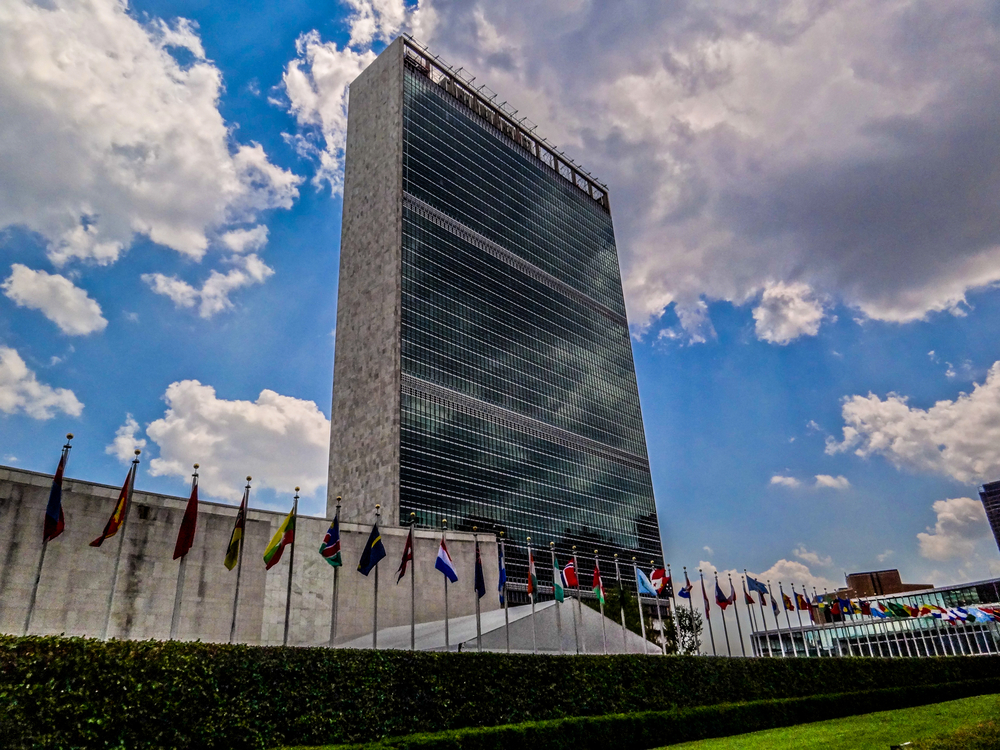
By Janet Ekstract NEW YORK – U.N. Secretary-General Antonio Guterres has been the target of protesters as they accuse him and the United Nations of not doing enough to end the war in Gaza. To that end, in an unprecedented move on July 22, the United Nations Security Council (UNSC) adopted a resolution urging all Member States to “utilize effectively” mechanisms for specific settlement of disputes as outlined in the United Nations Charter including “negotiation, inquiry, mediation, reconciliation, arbitration, judicial settlement” as well as other peaceful means, not resorting to violence to resolve disputes. Guterres highlighted what he said is “the horror show in Gaza” and called on member states to make greater efforts to achieve global peace. Addressing the U.N. Security Council, the U.N. chief also pointed out other ongoing conflicts in Ukraine, Sudan, Haiti and Myanmar and said: “Around the world, we see an utter disregard for – if not outright violations of international law,” adding there has also been a blatant disregard for the U.N. Charter. Guterres reiterated that “starvation is knocking on every door” in Gaza because Israel is preventing the U.N. the space and safety to deliver aid and save Palestinian lives. The U.N. chief cited the fact that in Gaza “hunger and displacement are at record levels,” further stating that security is practically non-existent due to terrorism, violent extremism and transnational crime. Guterres underscored the need for diplomacy, stating “Diplomacy may not have always succeeded in preventing conflicts, violence and instability,” adding “But it still holds the power to stop them.”
The UNSC told U.N. member countries that it should use a ministerial-level conference on Palestine on July 28-29 to publicly commit to concrete actions with the goal of ending decades of impunity for Israeli authorities’ violations of humanitarian and human rights law against Palestinians, Human Rights Watch said on July 22. The high-level conference on a Two-State Solution and Peace in the Middle East will be co-hosted by France and Saudi Arabia and take place in two phases: A ministerial meeting on July 28-29 and a second phase including heads of states and government prior to the U.N. General Assembly annual gathering of world leaders in September in New York City at U.N. headquarters. The conference comes as a response to a landmark July 2024 advisory opinion by the International Court of Justice (ICJ) on Israel’s occupation of the Palestinian Territory that handed down a decision, determining Israel’s decades-long occupation is unlawful and breaches Palestinians’ right to self-determination. The court found that Israel was responsible for apartheid and other serious abuses against the Palestinians, reiterating Israeli settlements are illegal and must be dismantled while stating that Palestinians are entitled to reparations.
Meanwhile, Chief Advocacy Officer Bruno Stagno at Human Rights Watch said, “It’s essential for governments to address Israel’s grave abuses by committing to concrete, timebound measure, including targeted sanctions, arms embargos, suspending preferential trade agreements, and a clear commitment to support the enforcement of all International Criminal Court arrest warrants.” Stagno added: “More platitudes about a two-state solution and peace process will do nothing to advance the conference’s goals nor to halt the extermination of Palestinians in Gaza.” Eyewitnesses, humanitarian aid staff, workers and journalists all have reported witnessing deliberate airstrikes and tactics that violate international humanitarian law. On its part, Israel consistently insists that it doesn’t intentionally fire on civilians and refutes claims to the contrary. The Israeli government and military also deny targeting aid staff as part of its war on Hamas while blaming U.N. agencies for their failure to deliver food it said it allowed in. According to multiple sources on the ground and the Executive Director for the World Food Program (WPF) Cindy McCain as well as other top humanitarian aid staff – Israel has not allowed any humanitarian or food aid into Gaza for almost three months. Prior to that, aid was barely trickling into Gaza, despite a plethora of nations calling on Israel to release aid sitting in trucks on the border crossing between Egypt and the Gaza Strip.
Human Rights Watch said the red line for the serious risk of genocide against Palestinians was violated long ago. This is why South Africa brought a genocide case against Israel to the ICJ in 2024 in response to Israeli forces systematic destruction of Palestinian homes, apartment buildings, orchards, fields, schools, hospitals, water and sanitation facilities in Gaza as well as Israel’s use of starvation as a weapon of war. In September 2024, the U.N. General Assembly endorsed the ICJ ruling and set a one-year deadline for Israel to end “its unlawful presence in the Occupied Palestinian Territory (OPT).” The upcoming ministerial conference was scheduled because of continued hostilities in Israeli-occupied Gaza that includes war crimes, crimes against humanity of extermination, forced displacement and acts of genocide. The crimes are in contravention of three binding ICJ rulings in the case brought by South Africa and the International Criminal Court (ICC) had issued arrest warrants for Israeli Prime Minister Netanyahu and his former defense minister Yoav Gallant for war crimes and crimes against humanity. Israel and the Trump administration continue to deny the genocide allegations while U.S. President Donald Trump moved to file sanctions against the ICC on February 7, 2025 by signing an executive order sanctioning the ICC, accusing it of engaging in “illegitimate and baseless actions” targeting the United States and its ally, Israel. The ICC whose job it is to prosecute individuals for serious international crimes was condemned by the U.S. and Israel for the arrest warrants. The ICC had also issued a warrant for Hamas official Mohammed Deif, the accused mastermind of the October 7 attack but Hamas confirmed that Deif was killed in an airstrike in 2024. On the issue of genocide, the U.N. has declared that “States parties to the U.N. Convention on the Prevention and Punishment of the Crime of Genocide (Genocide Convention) have an obligation to “employ all tools reasonably at their disposal” to prevent genocide. That obligation is triggered when a state learns, or should normally have learned, of a werious risk that genocide may be committed.”