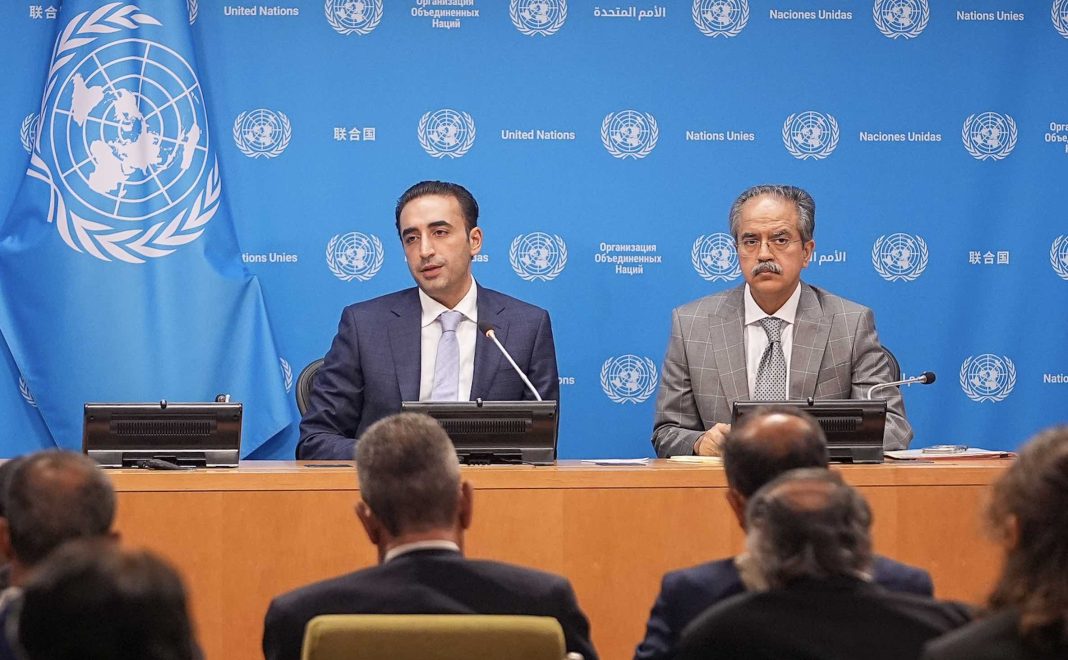
By Janet Ekstract NEW YORK – In a bid to promote peace with India, Pakistan’s former foreign minister and a member of the National Assembly of Pakistan, presided over a high-level parliamentary delegation on June 3 at U.N. headquarters in New York City, to meet United Nations Security Council President H.E. Ambassador Carolyn Rodrigues-Birkett, Permanent Representative of the Republic of Guyana. The meeting was part of Pakistan’s sustained diplomatic outreach to brief key U.N. stakeholders on the worsening regional situation between Pakistan and India. This follows on the heels of recent provocations from India that also included outright aggression that Bhutto Zardari said Pakistan had diligently refrained from further escalating. Bhutto Zardari who spoke at a press briefing at the U.N. on June 3, explained Pakistan’s position on India and expressed his desire for dialogue to pursue a resolution between the two countries.
Pakistan’s visit focused on an incident that took place on April 22, 2025 in Pahalgam, Indian-administered Kashmir where civilians were fired upon suddenly by alleged terrorists, according to India who blamed a terrorist infrastructure in Pakistan for the attack. Bhutto Zardari said that though Pakistan could have responded with a full-scale attack, it only took down six aircraft though it was prepared to take on three times that amount. In response, India launched military strikes against what it labeled as Pakistani terrorist infrastructure with Bhutto Zardari countering there was never any evidence or substantiation that Pakistan was responsible for the attack on civilians that day. Pakistan did respond with its own military operations that included air attacks but as Bhutto Zardari reiterated, Pakistan’s response to Indian aggression was restrained. Bhutto began his press briefing by explaining that “Pakistan has condemned terrorism in all its forms,” adding that India refused Pakistan’s offer of a full investigation, saying “we never initiated any strikes on India.”
In addition, the Pakistani delegation underscored the need for the United Nations Security Council (UNSC) to play a critical role in light of the growing trend in unilateralism and escalation, making it even more necessary for the UNSC to guarantee peace and conflict resolution. The Pakistani delegation also urged the UNSC to push for de-escalation while ensuring respect for international law and treaties and facilitating peaceful resolution of any disputes, including the Jammu and Kashmir dispute in line with the Security Council resolutions. As well, Rodrigues-Birkett reaffirmed the Security Council’s commitment to upholding international peace and security in line with its mandate. Meanwhile, Bhutto Zardari emphasized that it’s absolutely essential for “Pakistan and the international community to continue to pursue dialogue and diplomacy.” He added, “We would like to have comprehensive dialogue with India,” but added a cautionary note that India is in “violation of the Indus Water Treaty” that “must be condemned across the board.” While Bhutto Zardari admitted that the “single largest number of terrorist attacks take place in Pakistan,” he also said that India must stop engaging in disinformation campaigns to smear Pakistan. He reiterated that “India is using terrorism to justify illegal actions” and that a country “cannot combat terrorism if you’re going to use it as a political tool.” When Bhutto Zardari was asked about future tensions between India and Pakistan, he acknowledged that it’s a pressing concern which is why he reiterated that “diplomacy and dialogue” are the only route to resolving issues between the two neighboring nations.
As much as Bhutto Zardari underscored how crucial dialogue and diplomacy are – the former Pakistani foreign minister accused India of being a “rogue state” and of weaponizing terrorism. As Bhutto Zardari remarked: “We have not discussed terrorism with India. We have no intelligence sharing or information on terrorism between the two countries.” He added, referring to India: “You insist you’re so passionate about terrorism but you refuse to work with other countries on resolving terrorism.” As Bhutto Zardari reflected on Pakistan’s response to India’s military strikes: “One of Pakistan’s greatest strengths was our transparency. We did shoot down six planes, we showed restraint. We had 20 locked but we only shot down six, the Pakistani military demonstrated immense restraint and only targeted those six planes.” The prominent politician was wistful about a peaceful future with India: “Pakistan would still like to cooperate with India to combat terrorism,” adding “In addition to a dialogue on terrorism, where, hopefully, we’re able to agree on some type of mechanism” to cooperate to track terrorists.
It was clear from his press briefing, that Bhutto Zardari has been frustrated with India’s position on Pakistan which he reiterated has been rife with the spread of disinformation and misinformation to the Indian public and international community. As Bhutto Zardari had stated previously, “The root cause is the unresolved agenda of Kashmir. For the U.N. Security Council India made a promise to the international community and that promise has not been kept.” Throughout the press briefing, Bhutto Zardari made it clear that his country’s definitive objective is achieving a lasting peace and cooperation with India but he also made it clear that India’s leader Narendra Modi must heed to transparency. As Bhutto Zardari concluded: “It goes to show one country is telling the truth to its country, its people and the media and the other country who is not.” He added: “It should be obvious to all who is on the right side of history and who is not.” Reminding everyone of Pakistan’s position, Bhutto Zardari posed the question: “But I ask any country if their lifeline was being cut, if their water supply was being cut, how would they react? No civilized country must allow for this precedent.”