By Janet Ekstract
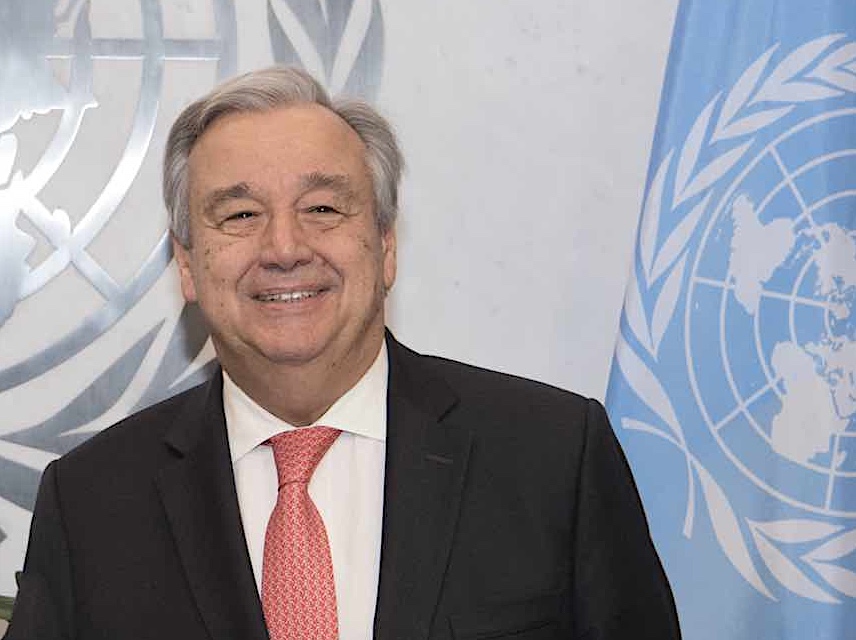
NEW YORK- On Tuesday, in his opening remarks at the 77th United Nations General Assembly, UN Secretary-General Antonio Guterres delivered a scathing report on the current state of the world and said “the climate crisis is the dividing issue of our time.” Guterres called out fossil fuel companies, private equity, financial institutions and banks on their support for fossil fuel during a time when he said that greenhouse gas emissions are skyrocketing by 14 percent and there’s too much discussion but not enough action. Guterres sounded the alarm: “We are in rough seas – our planet is burning.” He reiterated “the most vulnerable are suffering” and said, “We have a duty to act and yet we are gridlocked in colossal global dysfunction.”
Guterres began by praising the Ukraine grain export agreement, explaining that the reason Ukraine and Russia were able to work out the deal was due to “multilateral negotiation in action.” He added that there needs to be more hope and more action on the part of G20 economies to assist developing countries with meeting Sustainable Development Goals (SDGs). Guterres commented on the grain ship: “This ship is a symbol of what we can establish when we act together.” He further explained that there is a serious “global fertilizer market crunch” and African farmers suffer exponentially because of this situation as do developed countries. He added: “The global community is not ready or not willing to tackle the challenges of our ages.”
The secretary-general warned: “Our world is in peril and paralyzed,” adding “we cannot go on like this.” He said that while much of the world’s attention is focused on the Russian invasion of Ukraine “with massive violations of human rights,” artificial intelligence is compromising media, democracy and information systems. Guterres warned that “we risk ending up with no dialogue, no collective problem solving.” He underscored a myriad of global challenges facing the world and the UN, that include the rights of women and girls in Afghanistan, new conflict in Ethiopia, Haiti’s dire conditions, Libya’s political divisions that jeopardize peace, no sign of a nuclear deal with Iran, continuing violence between Israel and Palestine with “appalling humanitarian and human rights in Myanmar and a host of other countries. This leads to global instability, he said and with the threat of a nuclear disaster in Ukraine – Guterres reiterated the world is much worse that it was.
The secretary-general emphasized that human rights must be recognized as “pivotal” on the path to resolving conflicts. Guterres said that “planet Earth is the victim of scorched earth policies” with a million species at risk of extinction, with women and girls the most affected in every climate disaster. He said disarmament must be intensified and peacekeeping groups increased around the world. Guterres reiterated: “In all we do, we must recognize that human rights are at the center of forging lasting peace.” The UN chief minced no words when he said: “Let’s tell it like it is, our world is addicted to fossil fuels,” while explaining that climate crisis should be “the first priority” of every government.
Guterres blasted those financing fossil fuel and said: “The G20 emits 80 percent of all greenhouse gas emissions while feasting on hundreds of billions of dollars of subsidies and windfall profits while household budgets shrink and our planet burns.” The UN chief commented: “We need to hold fossil fuel companies and their neighbors to account, including banks, private equity, asset managers and other financial institutions that continue to invest in this PR machine, raking in billions to shield fossil fuel industry from scrutiny. Fossil fuel interests need to spend less time averting a PR disaster and more time averting a planetary one.”
The UN chief took a tougher stance on climate: “It’s high time to put fossil fuel enablers and looters on notice,” Guterres said. Acknowledging that quitting fossil fuels is a gradual process, he appealed to all world leaders “to realize the goals of The Paris Agreement,” reminding everyone that “a just transition, leaves no person or country behind.” He urged leaders to listen to their citizen’s calls for change and invest in solutions that lead to “sustainable economic growth.” Guterres pointed out that “renewable energy generates three times the jobs and it’s already cheaper than fossil fuel.” He proposed redirecting funds that would otherwise go to fossil fuel companies to countries suffering losses from climate crisis and people struggling with rising food and energy prices. Appealing to leaders, Guterres remarked: “Developing countries need help to make this shift,” and that countries must be assisted to adapt to worsening climate shocks. He added that doubling adaptation funding was agreed to in Glasgow last year and must be committed to and that “multilateral development banks must step up and deliver. Major economies are their shareholders and must make it happen while adding that “solidarity and trust are fundamental to climate justice.”
“It’s high time to move beyond endless discussions,” Guterres warned – adding that “vulnerable countries need meaningful action.” He referred to the biodiversity crisis and said leaders must make that conference a success and that the world must agree on the G20 Biodiversity Framework by setting ambitious targets, providing adequate funding and eliminating some subsidies that destroy ecosystems “on which everyone depends.” Guterres urged members to finalize what he termed as an “international, legally binding agreement to conserve and sustainably use marine and biological diversity.” He added: “We must protect the ocean now and for the future.” The UN leader warned: “Social unrest is inevitable with conflict not far behind” if the climate crisis isn’t addressed immediately. On a hopeful note, Guterres said: “It’s not impossible to have a world without poverty,” adding “the SDGs are issuing an SOS.” The secretary-general said he is calling for the launch of an SDG STEEPLE “whereby the G20 massively boost sustainable development for developing countries.” He added that multilateral banks need to “increase their appetite for risk” so they can be an “effective mechanism” for funding developing and middle-income countries in debt distress. Guterres suggested liquidity lines be extended to prevent the dangerous divergence of developing countries that currently threatens global stability, he said.