When you stand before a canvas, what do you feel?
What is that spark inside you as you transfer a word onto paper?
What, truly, is art?
Is it the dance of colors?
Or the spatial echo of intention?
Perhaps the organized form of a thought — much like a line of code.
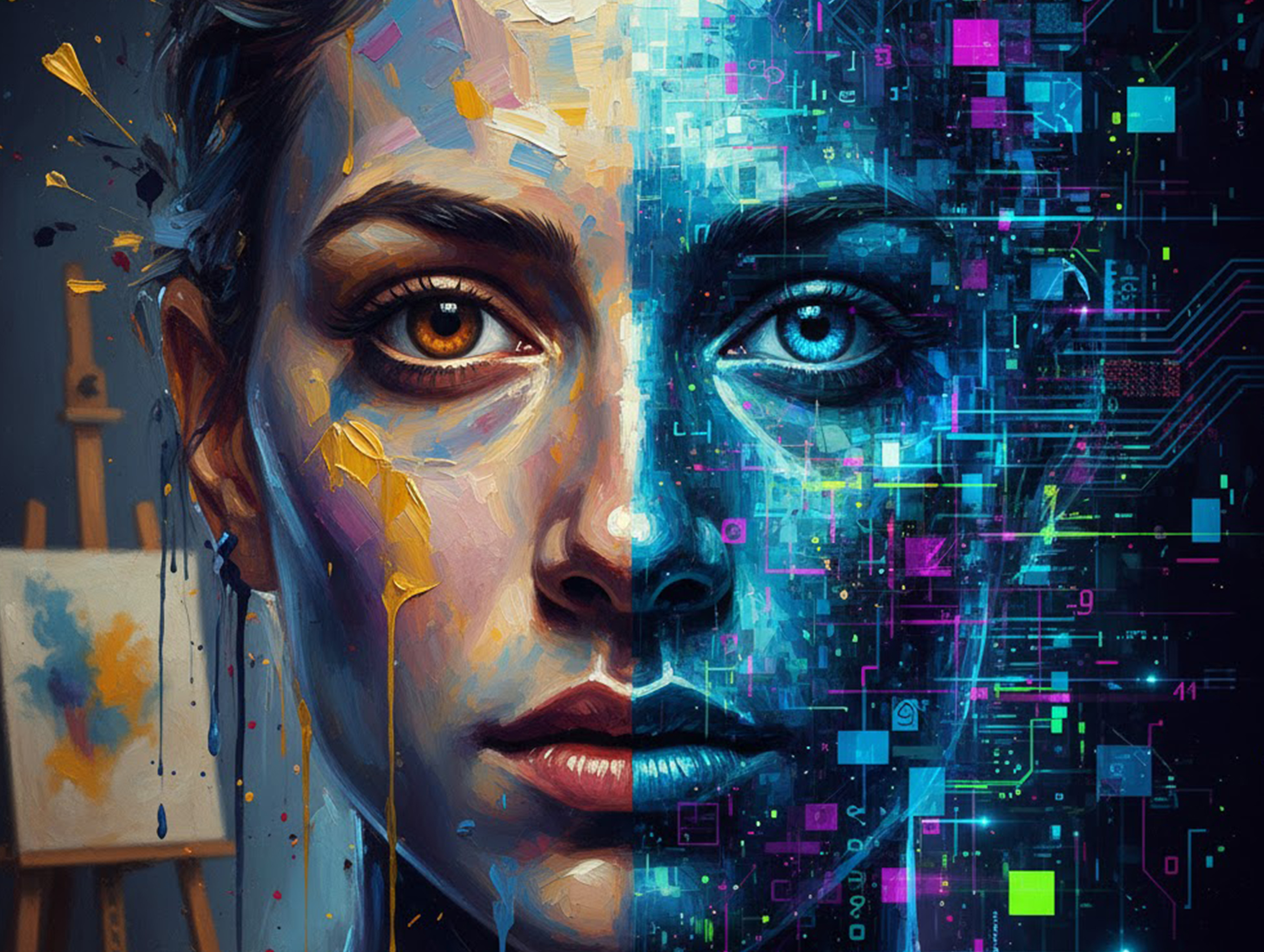
Today, these questions grow sharper than ever. Because art is no longer born solely from the human soul, but also from the dim chamber of machine intelligence. This era we call “AI Art” heralds a subtle fracture in the age-old relationship humanity had with creativity. In this context I invariably recall the observer effect and the double-slit experiment. In a world where mere observation can alter existence, what mirror does AI-generated content hold up to our state of consciousness? Art, perhaps for the first time, faces neither invention nor discovery—but something altogether different—and in that lies the intrigue.
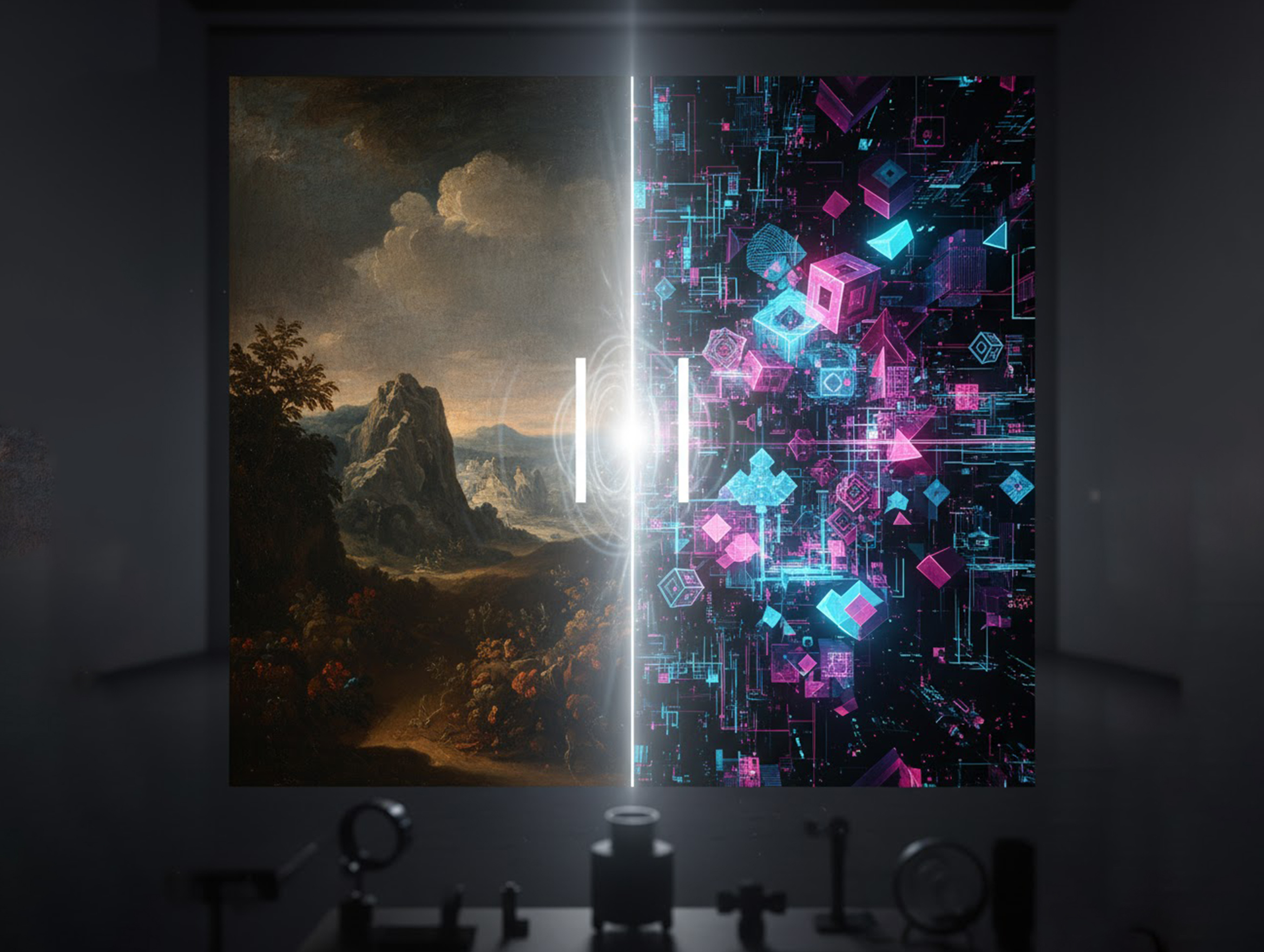
Creativity as Code
Modern art tools function like interfaces that merge computer architecture with imagination. The artist’s brush becomes a “prompt,” the canvas a screen, the model a neural network. Even the prompt creation often involves employing a painter’s, photographer’s or filmmaker’s style as synthetic data—underscoring just how intertwined the process has become.
For many artists this is liberation: the generation of unlimited imagery.
Yet for others it represents a heavy blow to the sanctity of creation.
In this debate appears a sharp insight:
“A visual made by AI shows not the artist’s intuition, but the database’s average.”
And art, after all, does not dwell in the average but in the deviation.
The artist follows intuition—not statistics.
Machine Aesthetic: Emotions Replicated
In an AI-generated portrait the play of light, in a poem the rhythm, in music the emotional tension—each is now subject matter for algorithmic learning.
But there’s a crucial difference:
AI knows what it makes you feel, but it does not know why it makes you feel it.
That is where art doesn’t die—it merely changes form.
As machines become “emotion producers,” human artists remain the architects of feeling.
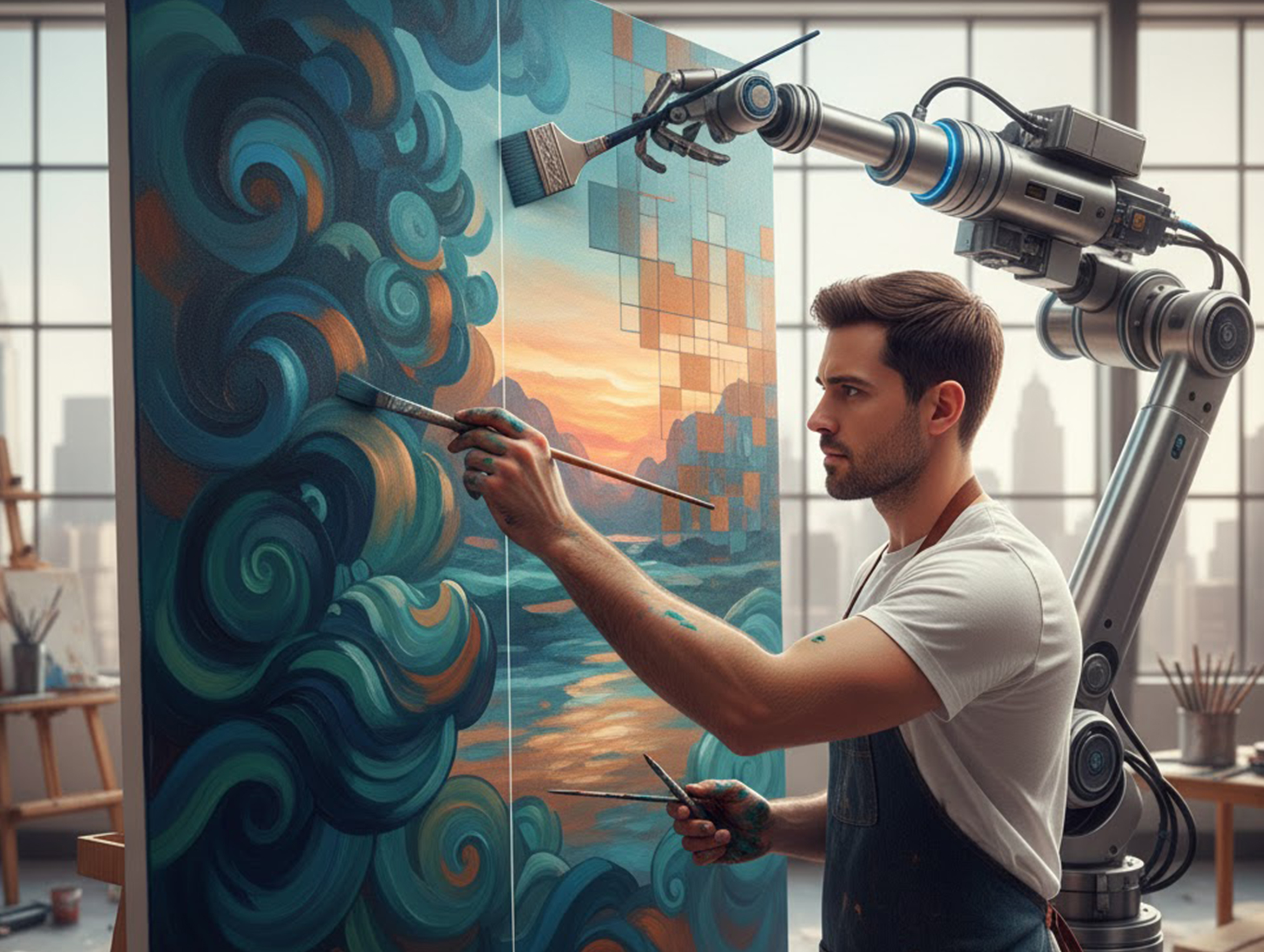
Defining Art: Production or Awareness?
When we look at a painting, a film sequence, even a musical piece today—what must we ask?
“Who created this?”
Or rather: “What created this?”
Media theorist Douglas Rushkoff remarks in Team Human:
“If technology starts optimizing humans instead of empowering them, art no longer reflects the human—it reflects the machine.”
This warning points to a pivotal turning point in art’s future. If technology begins to optimize rather than amplify humanity, art risks losing the human measure.
A Personal Note: Not Loss, but Evolution
I don’t see this transformation as the death of art—it is the evolution of consciousness. When I gaze at an AI-generated work, I see not only a model but a shadow of collective consciousness. This does not scare me—it fascinates me. Perhaps for the first time, art becomes the expression of the species, not just the individual.
Yet one thing remains:
A human cannot create art where meaning is lost.
And meaning always begins with the rhythm of a heart—not of an algorithm.
Final Word: Who Holds the Brush?
Art has not died.
The hand that holds the brush may no longer be purely human.
AI can mix colors on a canvas, generate a photograph, complete a screenplay.
But the human remains the sole entity choosing the meaning of those colors.
Perhaps the future of art lies in the silent partnership between these two:
Between the machine’s memory and the human’s intuition, an unnamed image is born.