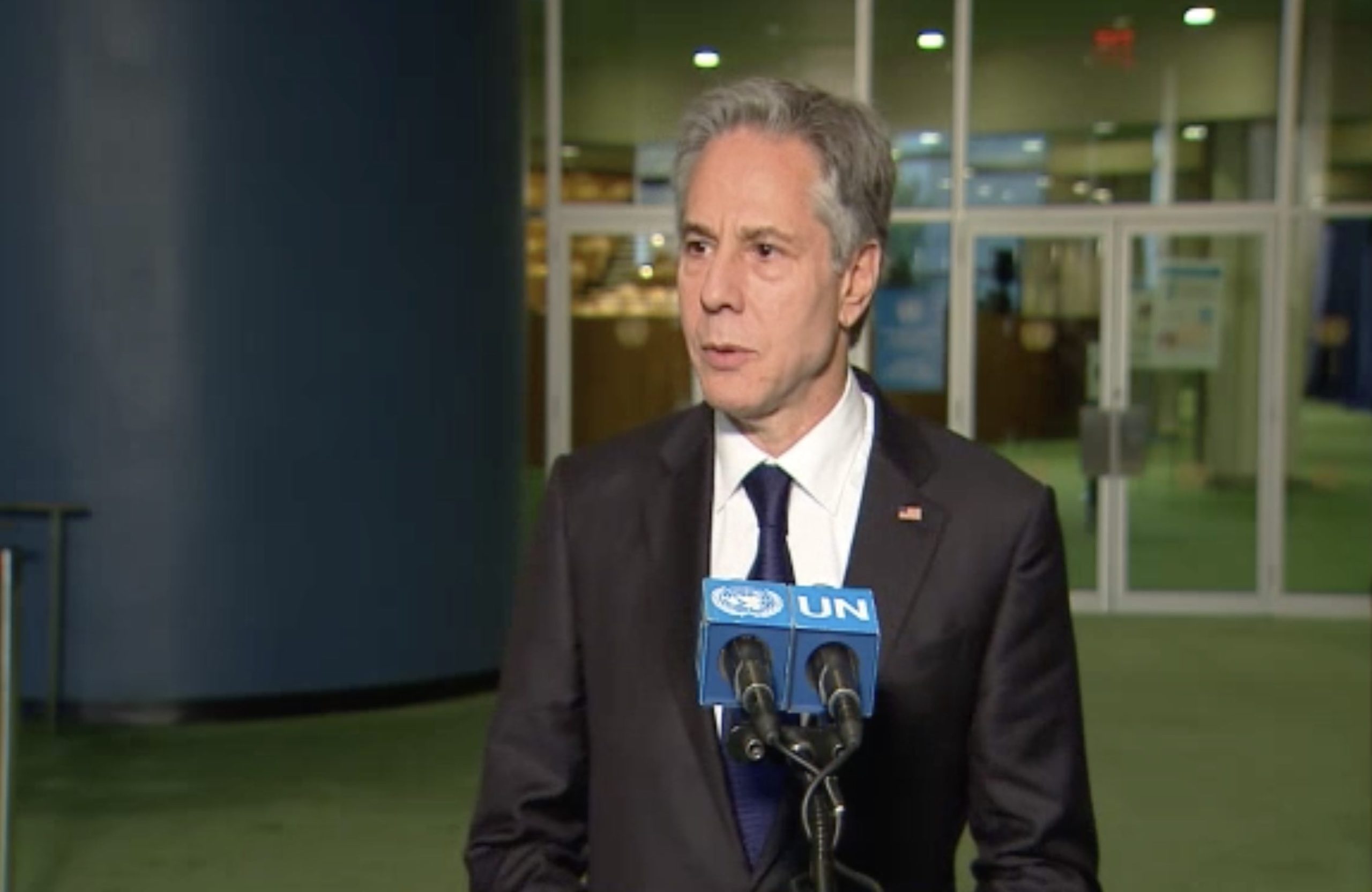
By Janet Ekstract – United Nations – U.S. Secretary of State Antony Blinken in a formal statement after last week’s 78th United Nations General Assembly (UNGA) reiterated the need to “address challenges no nation can solve alone.” Blinken said that what’s required moving forward is the “need for cooperation” on a broad scale and working for a “common cause.” He commented that the goal is to use American diplomacy to “mobilize effective coalitions” to work toward meeting the most pressing challenges faced by the world right now. A major priority, Blinken explained is President Biden’s goal for nations to cooperate to meet U.N. Sustainable Development Goals (SDGs), reforming multilateral development banks to meet the needs of low and middle income countries, investing in infrastructure that creates a foundation for broad-based economic opportunity, dealing with the climate crisis and strengthening health and food security. As Blinken commented: “We gathered governments, artificial intelligence developers, civil society to help direct AI toward meeting the Sustainable Development Goals, to making sure that it is used for good to advance the progress that we know we need. Fostering its positive uses, minimizing its negative uses is a key part of what the United States is working to do every day, including around the world.”
Blinken reiterated that the U.S. is the global “leading contributor” to all of those efforts and said that Biden has pledged continued support for the U.S. role on these crucial fronts. He emphasized that the precepts of the United Nations Charter are essential to defend and that international peace and security is a priority to promote. Blinken added that without peace and security that goals won’t be easily achieved and that a major aim is to create more freedom with a more open, secure and prosperous global agenda. As he stressed, these are not ‘either or’ priorities, they are inclusive and the overall goal is to achieve all of them. He explained that positive solutions are being put forth to address the numerous global challenges currently faced by nations around the world.
In order to deal with those challenges, Blinken said that the U.S. president has launched and is addressing the Partnership for Global Infrastructure Investment, or PGI. To that end, private sector leaders gathered to mobilize additional investment along with the billions the U.S. and its G7 partners already invested toward the goal of delivering $600 billion in high-quality infrastructure investment by the year 2027. Another program is VACS which works in tandem with the African Union and the U.N. on food security and assisting African nations develop their own sustainable and effective food sources. Blinken said the focus is on ensuring the most nutritious African crops will be produced for this purpose with work on breeding climate-resistant varieties while enhancing the soil they are grown in. He highlighted that the focus is on seeds and soil – a major component in meeting the global demand for food and to ensure African countries are self-reliant.
To achieve this goal, Blinken said that countries in support of the multilateral mission in Haiti that the U.N. is involved in were convened and that Kenya indicated it wants to take the lead. The secretary of state said in coming weeks, the U.N. Security Council will endorse this and that stabilizing Haiti is critical for its political transition, humanitarian assistance and development. Blinken also mentioned fit-for-purpose coalitions whose purpose will be to “tackle emerging challenges.” The Global Coalition to Address Synthetic Drug Threats brought over 100 nations together with joint plans being developed on a plan of action to deal with every aspect of the synthetic drug problem on the fronts of public health, regulatory as well as security solutions. This will all be centered on cooperative work between countries and organizations, Blinken underscored and said it’s the primary killer of Americans aged 18-49, citing the drug fentanyl as a major issue in the U.S. and worldwide. He said the need is to find global solutions that can be applied across the board.
Blinken said that the 78th UNGA was the first time that there was a leaders-level meeting of the C5+1 – a group that gathers Central Asian partners to meet with the U.S and this included meetings with the Quad, Gulf Cooperation Council and ECOWAS. He added that the Partnership for Atlantic Cooperation with over 30 countries from four continents, met to promote sustainable ocean economy, advance greater scientific and technological cooperation as well as to address the climate crisis. In the Security Council, Blinken said that member-states from every region “condemned Russia’s war on Ukraine” while they “affirmed Ukraine’s right to sovereignty and territorial integrity. They expressed support for a just and lasting peace.” Blinken pointed out that work moved forward on these priorities in meetings with world leaders and that he met with over 90 countries in bilateral and multilateral meetings at the UNGA. Blinken said this included constructive meetings with China’s Vice President Han Zheng that demonstrated positive will to work toward common goals “while managing our competition responsibly.” As Blinken summed up the UNGA meetings, he said the international community depends on the U.S. to “bring countries together in a way that’s affirmative, that’s inclusive, and that meets the real challenges that people face, while at the same time upholding the basic principles of the international system that we know are vital to maintaining peace and stability.”