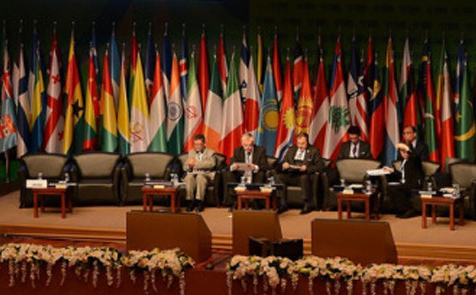
By Janet Ekstract NEW YORK – In the midst of the International Monetary Fund’s (IMF) spring meetings in Washington D.C. from April 21 to April 26, hundreds of finance and trade delegates are scrambling to make deals after U.S. President Donald Trump declared higher tariffs on imports for a plethora of countries. Though Trump claims the tariffs are necessary to even the trade playing field, a majority of analysts and economists view them as not only problematic for the economy but for trade partners as well. On April 22, IMF Chief Economist and Director of Research, Pierre-Oliver Gourinchas announced that the tariffs are projected to be “negative for all regions.” Gourinchas said: “Our assessment is that it is going to be negative.” He added that the tariff situation will be “negative for all regions in the short term, in the medium term and in the long term.” Meanwhile, Chief Economist for the Milken Institute, William Lee told Al Jazeera news that despite Trump’s tariffs, that “even though the recession probabilities have gone up, they still remain below fifty percent.” Lee said, “The greatest risk to global trade is the system itself” and added that it is “no longer satisfying needs of emerging markets.” Milken’s chief economist further stated that the U.S. is not as heavily dependent on trade as other countries who he said are “heavily dependent on commodity trade” and that current trade talks “behind closed doors are the most important discussions we’ve had in decades.”
Lee commented that “Trade is very important for the rest of the world, but for the United States trade is not that important because imports are only 14% of GDP and exports are only 11% of GDP.” He added that “The fears of changing trade flows is very substantial,” adding “They need to redesign the trade system” while warning that the “system is antiquated and no longer serves the needs of 21st century trade.” Lee said he was referring to the World Trade Organization (WTO) system of trade set up after World War II, also adding, that until now, no one has stood up to admit the trade system must undergo change. In light of all this, the IMF cut growth forecasts for the U.S., China and most countries due to the impact of U.S. tariffs – cautioning that increasing trade tensions could slow growth even further. Meanwhile, global finance chiefs didn’t waste any time in racing to achieve negotiations to bring down Trump’s tariffs. White House Press Secretary Karoline Leavitt told the press that 18 different countries have put proposals on the table and that Trump’s negotiating team is scheduled to meet with 34 countries to discuss tariffs, this week. Trump told reporters that he is confident that a trade deal could be reached with China that he said could “substantially” cut tariffs and lift markets.